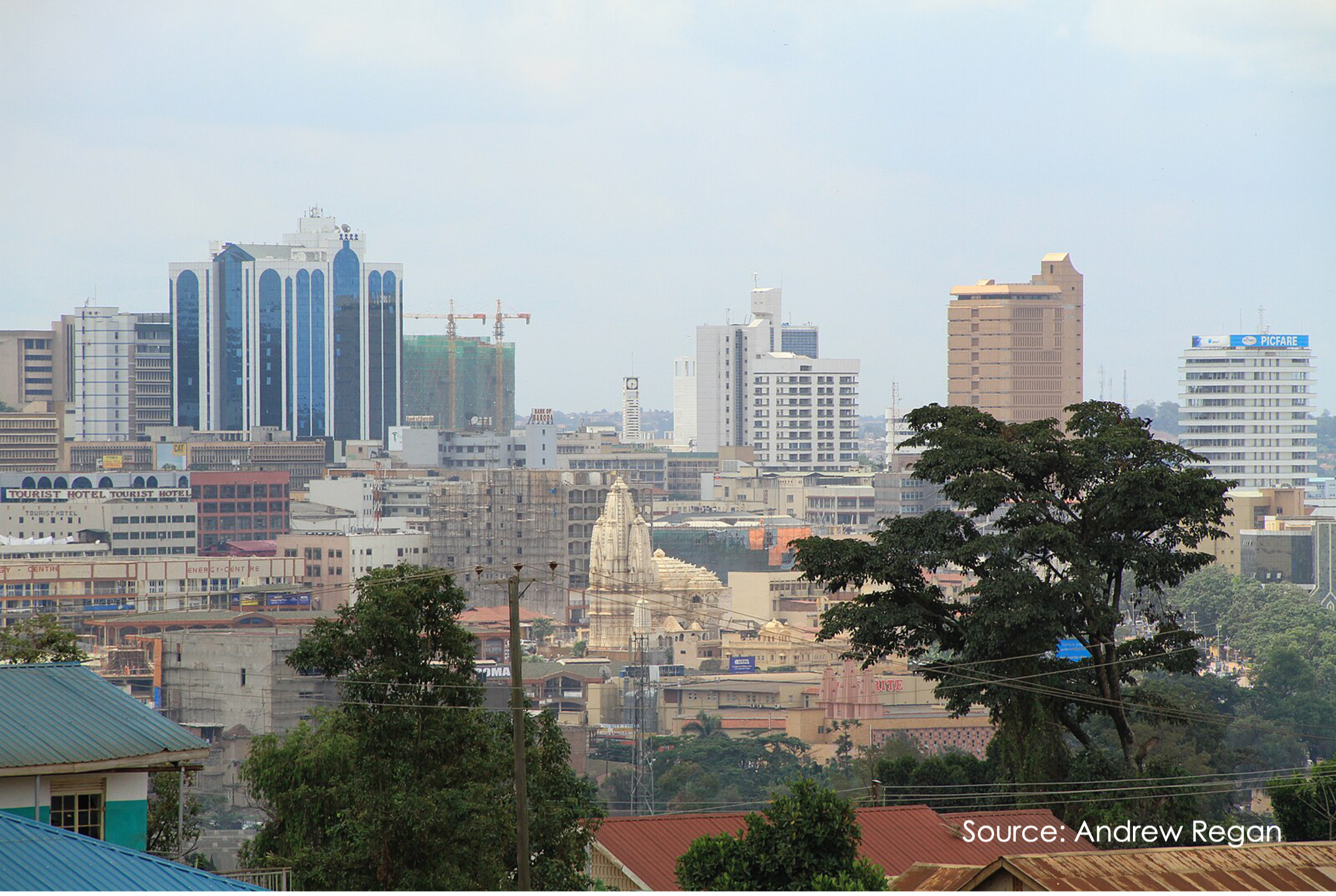
| Imagery Source: Wikimedia Commons / Andrew Regan |
| Information Source: African Development Bank |
| Recent macroeconomic and financial developments |
| Uganda’s economy expanded 4.6% in 2023, lower than the 6.3% registered in 2022. Despite strong performance in mining, construction, and hospitality, lower manufacturing output and contractions in food production and public administration led to the slowdown. Tight fiscal policy contributed to slower economic growth, despite large investments in oil and gas. Consumer demand and foreign investment remain robust. Monetary policy has been tight, with the Bank of Uganda setting the policy rate at 10.25%. Inflation declined from 7.2% in 2022 to 5.5% in 2023. Net foreign assets declined during the second half of 2023, marginally depreciating the shilling-US–US dollar exchange rate by 1.8% in 2023. |
| The government continues its fiscal consolidation, focusing on reducing current and development expenditures more than on boosting domestic revenue. The deficit narrowed from 7.4% of GDP in 2021/22 to an estimated 5.1% in 2022/23. Since the rapid rise in public debt in response to the COVID-19 pandemic, public borrowing has been stabilising. Despite a small increase in the debt-to-GDP ratio from 46.3% in 2020 to 49.6% in 2023, the risk of public debt distress is moderate, with the debt level considered sustainable. The current account deficit narrowed in 2023 but remained elevated at 7.9% of GDP. With the ratio of nonperforming loans to gross loans at 4.6% and a capital adequacy ratio (tier-1 capital to risk-weighted assets) of 25.3% in 2023, the financial sector remains well capitalised and able to withstand external shocks. |
| Previous gains in poverty reduction are reversing, with the poverty rate rising from 21.4% in 2017 to 30.1% in 2020. |
| Outlook and risks |
| The economy is projected to expand by 6.0% in 2024 and 7.0% in 2025, buoyed by stronger regional growth as global supply chains normalise. The oil sector will continue ramping up investments in wells and pipelines, further underpinning growth and future exports. Rising imports of goods and services will keep the current account deficit elevated. Inflation is expected to converge to 5% as the Bank of Uganda maintains its tight monetary policy. The fiscal position is expected to further improve with continuing consolidation efforts. Nonetheless, external risks are tilted toward the downside. Supply chain disruptions around the Red Sea could slow trade as risk premiums rise, while intensifying regional insecurity could delay investments. Domestic risks are related to unexpected increases in public spending on infrastructure amid weak tax revenue performance. The International Monetary Fund’s extended Credit Facility will bolster reserves and set performance targets to guide the authorities. |
| Reform of the global financial architecture |
| Despite a shift from agriculture to services, Uganda’s structural transformation remains incomplete. Agriculture’s contribution to GDP has declined from 53% in 1990 to 24% in 2022, yet 7 of 10 Ugandans are still subsistence farmers and working in low-value-added agricultural jobs, with agricultural labour productivity rising by just 26%. While productivity has advanced 294% in manufacturing and 164% in trade services, these sectors employ a small fraction of the workforce. Manufactured exports constituted only 13% of total exports in 2022. Accelerating structural transformation requires boosting agricultural productivity and investing in firms and jobs in industrial sectors and services. Also critical is scaling up skilling, promoting innovation through research, and boosting the mechanisation of agriculture. |
| The transition to higher value-added jobs requires greater investment in industry and services. Uganda receives $2 billion annually from development partners, but most of it is directed to social sectors. In the short term, the government could negotiate a reallocation of financing to productive sectors. Stronger collaboration between international financial institutions and the private sector is vital to providing risk capital for investment, for example, a green industrial finance facility. Over the medium term, the government should increase financing for quality infrastructure and production factors to improve Uganda’s export competitiveness, for example, by harnessing the Global Gateway or Belt and Road Initiatives. |
| For the full document, click the link below |
| Uganda: Economic Outlook and GDP |
| Stay ahead of the curve! Subscribe to InsidEntity for daily updates on all your favourite companies. |