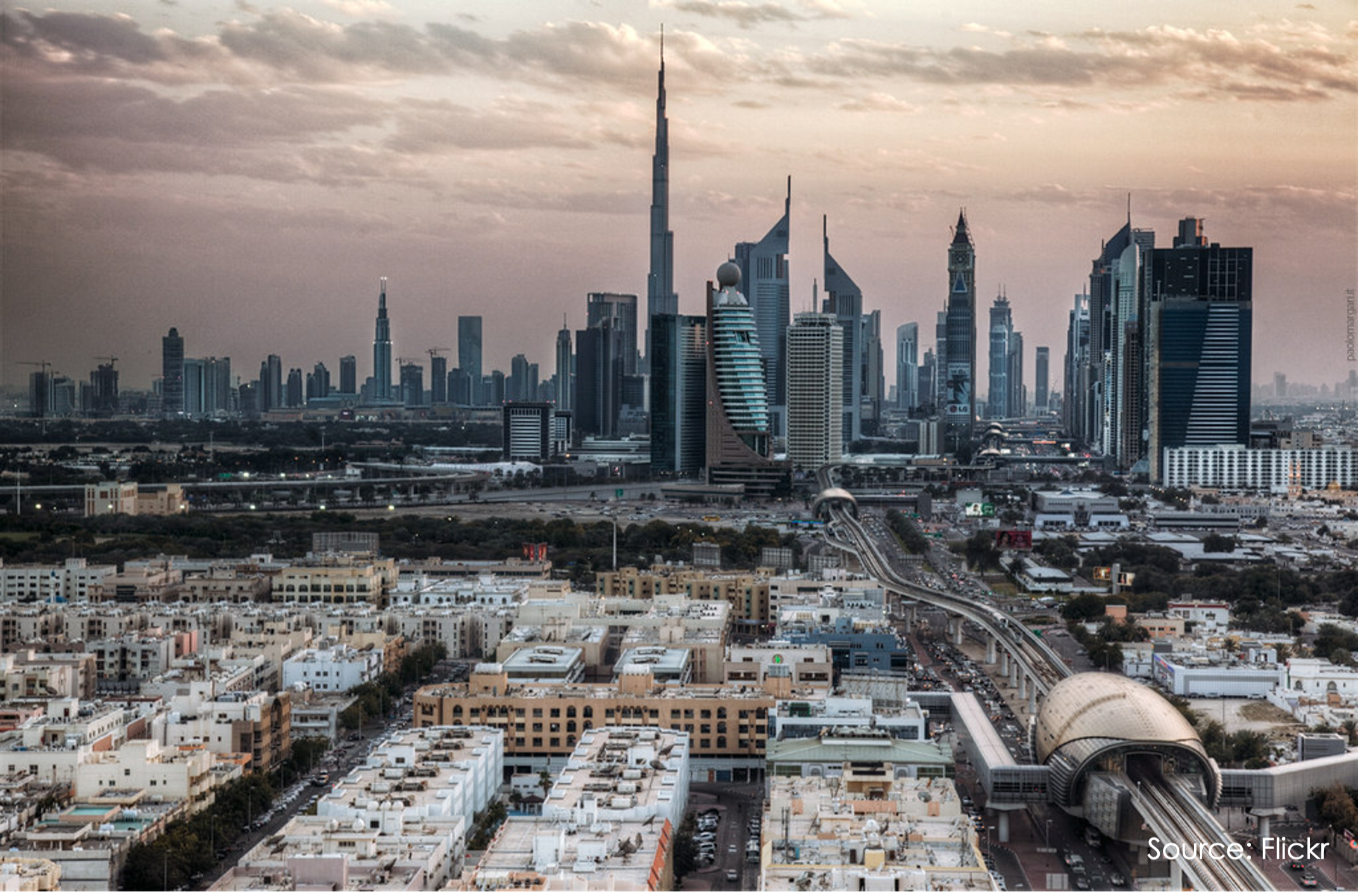
| Imagery Source: Flickr |
| Information Source: Central Bank of the U.A.E. |
| The global economy is projected to grow by 3.3% in 2025, according to the latest IMF forecast, marking a marginal 0.1 percentage points upward revision from the previous estimate. The IMF has also raised its US GDP growth forecast to 2.7% for 2025, citing strong consumer spending and investment despite a softening labour market. However, growth is expected to moderate toward its potential rate by 2026. For other advanced economies, growth is projected to average 1.9% in 2025, with the euro area lagging at 1.0% due to manufacturing weaknesses. Meanwhile, growth in emerging markets and developing economies is expected to remain steady at 4.2% in 2025, with a slight increase to 4.3% in 2026, supported by Asia’s resilience but constrained by structural challenges, climate shocks, and regional instability. |
| Global inflation is steadily easing, driven by unwinding supply-side pressures, softening labour markets, and goods price disinflation. Central banks in advanced economies have slowed the easing cycle as persistent price pressures in transportation and housing are preventing inflation from falling more rapidly. After 100 basis points (bps) of cuts in late 2024, the US Federal Reserve (Fed) held the Fed Funds rate target range steady at 4.25%-4.50%. Others, such as the ECB, have continued cutting rates to prop up flagging aggregate demand. With mixed labour market signals and ongoing policy uncertainties, such as US tariffs and retaliatory tariffs, central banks are maintaining a cautious, data-driven approach to rate adjustments. The trajectory of financial conditions will remain contingent on future economic developments, including the evolution of inflation, labour market dynamics, and global geopolitical risks. |
| The UAE's non-oil trade exceeded AED 2.0 trillion in the first nine months of 2024, equivalent to 135% of GDP. This corresponds to a 14.9% year-on-year (Y-o-Y) surge, reflecting the successful implementation of the UAE’s economic diversification plans and strengthening ties with its key trading partners. This robust performance, boosted by comprehensive economic partnership agreements, is expected to continue through 2025 and 2026, supporting real GDP growth projections of 4.7% in 2025 and accelerating to 5.7% in 2026. While OPEC+ decisions on oil production quotas will influence overall growth, the non-hydrocarbon sector remains robust, with forecasted growth of 5.1% and 4.8% in 2025 and 2026, respectively. The hydrocarbon sector is also accelerating due to the expected gradual lifting of oil production cuts starting in Q2 2025 and the full recovery of oil production, coupled with the developments in the natural gas sector next year. |
| Inflation in the UAE remained well-controlled at 1.7% in 2024, substantially below the global average of 5.7%, mainly due to lower tradeable inflation. The CBUAE maintained its inflation forecast for 2025 unchanged at 2.0%, significantly below the world average, with the non-tradable components of the consumer basket expected to be the main drivers. The inflation projection for 2026 also remained unchanged at 2.1%, primarily influenced by non-tradeable components and external factors. |
| The residential market in Abu Dhabi in 2024 experienced a 6.1% decline in the number of apartment and villa sales, after a record growth of 67% in the previous year. In Dubai, residential sales continued their upward trajectory with a 42.5% increase in the number of apartment and villa sales transactions. Rental transactions increased in both Abu Dhabi and Dubai, by 1.9% and 0.6%, respectively. |
| In 2024, Dubai further established itself as a premier tourism destination worldwide, achieving a hotel occupancy rate of 78% and a 9% Y-o-Y rise in overnight visitors, totalling 18.7 million. This growth made a notable impact on the non-oil economy. At the same time, the UAE’s transportation industry demonstrated solid performance during the first nine months of 2024, with a 7.9% increase compared to the previous year. These developments emphasise the UAE’s growing influence in global tourism and aviation. |
| In line with the Fed’s monetary easing cycle, the CBUAE cut its key policy rate (Base Rate) by 50 bps in Q4 to 4.40%. The Dirham Overnight Interest Average (DONIA) rate remains around 12 basis points below the Base Rate, reflecting sustained excess reserves. The banking sector's robust 12.9% Y-o-Y deposit growth in Q4 2024 further supported favourable funding and liquidity conditions. Loan portfolios also continued to expand, growing by 9.5% Y-o-Y at the end of Q4 2024, primarily driven by domestic lending. The UAE banking system remains resilient, underpinned by adequate capital, liquidity, and funding buffers. |
| In Q4 2024, Dubai Financial Market’s share price index rose by 22.4% Y-o-Y, while the Abu Dhabi Securities Market General Index fell by 1.8% Y-o-Y. Credit Default Swaps (CDS) premia for Abu Dhabi and Dubai remained low, underscoring UAthe E’s strong economy, robust fiscal position and large sovereign wealth funds. The insurance sector demonstrated robust growth, with gross written premiums increasing by 21.4% Y-o-Y and gross paid claims rising by 35.8% Y-o-Y in 2024. Technical provisions also grew by 25.6% Y-o-Y, and the sector maintained healthy capital adequacy and earnings ratios, reflecting its strong capitalisation. |
| For the full document, click the link below |
| UAE: Q1 2025 GDP |
| Stay ahead of the curve! Subscribe to InsidEntity for daily updates on all your favourite companies. |