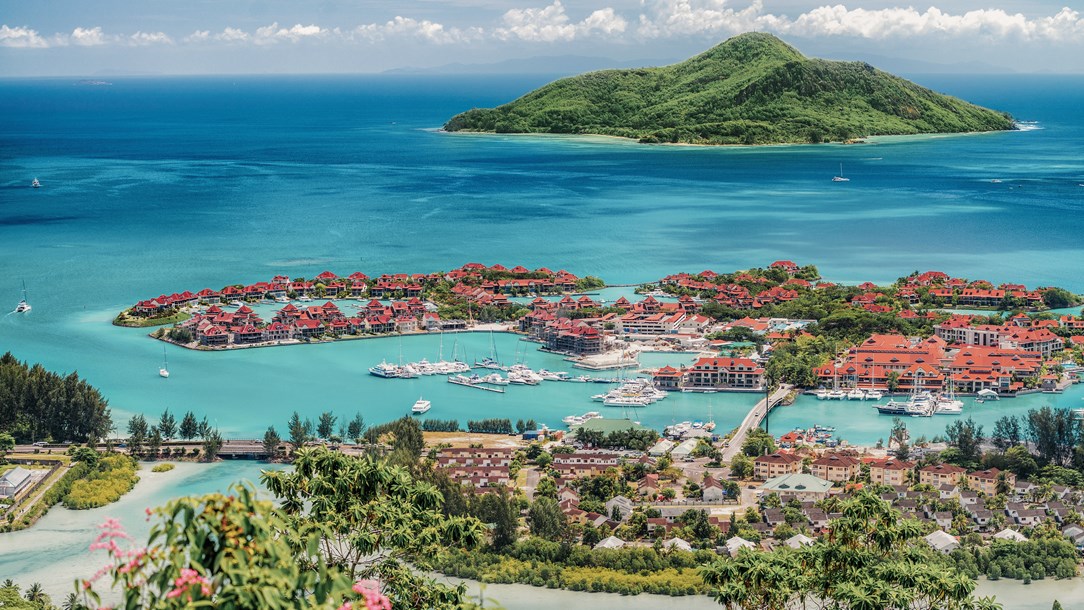
| The Republic of Seychelles is an archipelago of 115 islands northeast of Madagascar. The country has a total population of 121,355 people, three-quarters of whom live on the main island of Mahé. Seychelles has Africa's highest gross domestic product (GDP) per capita, at $16.7 billion (2023). Its economy is highly dependent on tourism and fisheries, and climate change poses long-term sustainability risks. |
| Political Context Independent since 1976, Seychelles is a relatively young democracy. The first multiparty presidential election was held in 1993 after the adoption of a new constitution. The latest presidential and parliamentary elections took place in October 2020, bringing an opposition candidate, Wavel Ramkalawan, to the Presidency for the first time since the introduction of democratic elections. Ramkalawan’s Linyon Democratic Seselwa party also won the most seats in the national parliament. With well-established democratic institutions, Seychelles' political environment is expected to remain stable. The next general election will take place in September 2025. |
| Economic Developments and Outlook Seychelles is the most prosperous nation in Sub-Saharan Africa. The economy remains highly dependent on tourism, with earnings from the industry accounting for 46.2% of GDP and 42% of exports, making it highly vulnerable to external shocks. The fisheries sector is the second pillar of the economy, with growing investor interest in the blue economy sector. |
| Growth is estimated at 3.2% in 2023, with services contributing 2.7 percentage points. Tourist arrivals in 2023 increased by 5.7% but remained 9% below pre-pandemic levels. The telecommunications sector grew by 15%, reflecting improved service offerings while new hotel and resort projects, along with renovations, spurred a 7% growth in the construction sector. Public sector salaries were revised up in 2023, increasing total average earnings by 4.6%, compared to the 0.1% growth in 2022. The continued recovery in tourism contributed to an increase in annual average employment by 2.2%, following growth of 8.1% in 2022. |
| Prices declined in 2023 due to exchange rate appreciation, with headline inflation averaging -1.0%. By mid-2024 core inflation remained negative at -0.9% yet headline inflation increased to 0.4% due to utility tariff hikes and higher freight costs associated with the Red Sea crisis. Consequently, falling prices prompted the Central Bank to reduce its monetary policy rate from 2.0% to 1.75% in April 2024 to support economic growth. |
| The Seychelles government remains committed to fiscal prudence after successive consolidation efforts implemented since 2021. Public debt is on a sustainable path and has declined to 58.3% of GDP in 2023. The current account deficit narrowed to an estimated 7.2% of GDP in 2023 which is primarily financed by foreign direct investments, equivalent to 13.2% of GDP, primarily from investments in hotels and resorts. The country’s foreign exchange reserves increased to $682 million in 2023, equivalent to 3.8 months of imports. |
| Development Challenges Despite its high-income status, Seychelles faces some development challenges centred on enhancing productivity and boosting overall economic performance to foster greater shared prosperity. The island state faces growing vulnerabilities due to limited economic diversification, insularity, small size, remoteness, susceptibility to climate shocks, and exposure to external shocks, including fluctuations in international travel and the prices of essential imports like food and fuel. Although it has the highest GDP per capita in the region, addressing labour and skills shortages and boosting social protection are key elements to improve human capital development. Despite a low unemployment rate of 3.2% and significant strides in reducing extreme poverty, 25.3% of the population is estimated to live below the national poverty line. Institutional barriers—such as inefficiencies in public sector management, challenges in starting and operating businesses, and limited access to quality education and skills development—further constrain progress. |
| Frequent disasters triggered by monsoon rains, floods, and landslides, compounded by events like the December 2023 explosion in an industrial area on Mahé island, underscore the need for climate adaptation and funding as well as enhancements in disaster risk management. In the near term, priorities include maintaining debt sustainability and reforming the social protection system to support the most vulnerable. In the medium term, the focus is to increase revenues, boost capital expenditures for climate change adaptation, and create fiscal space through prudent expenditure management and stronger revenue mobilization. Additionally, structural reforms in revenue administration, public financial management, and governance—alongside digitalization and state-owned enterprise reforms—are essential to Seychelles’ sustainable development. |
| The World Bank Group (WBG) strategy in Seychelles, outlined in the Country Partnership Framework (CPF) FY25-FY30, aims to support the country's transition to a more inclusive, resilient, and sustainable development path. The CPF addresses key challenges related to productivity, participation, and public sector performance. It focuses on enhancing the quality of life by creating more employment opportunities, especially for youth and women, improving the business environment for small and medium enterprises and entrepreneurs, and enhancing human capital through education and skills development. Additionally, the strategy promotes the digital economy, climate resilience, renewable energy adoption, and sustainable waste management, all while supporting public service digitalization. The WBG also aims to bolster social and environmental resilience by supporting policies that address climate change impacts and solid waste management. |
| A cross-cutting theme of the strategy is strengthened macro-fiscal resilience, which involves supporting Seychelles' continued commitment to macroeconomic prudence. This includes efficient public resource utilization to promote economic, social, and environmental resilience. Key strategies include enhancing skills development, supporting the digital economy, and promoting renewable energy adoption. |
| The World Bank portfolio in Seychelles stands at $60 million (including national projects and budget support) as of August 2024. In terms of core analytics, the World Bank is preparing a Country Climate Development Report, which integrates climate change and development, to help prioritize the most impactful actions that can reduce greenhouse gas (GHG) emissions and boost adaptation and resilience, while delivering on broader development goals. A Country Economic Memorandum is also planned to focus on jobs and raising productivity to meet the needs of an increasingly knowledge-based economy while promoting resilience. Jointly with the government, the World Bank launched a Solid Waste Management Project which aims to improve the financial and environmental performance of the waste management sector and to foster enhanced circularity. It also seeks to strengthen the quality of the Seychelles’ social protection system. |
| A combined total of $85 million has been disbursed under the Seychelles Fiscal Sustainability and Climate Resilience Development Policy Financing series of three operations from 2022 to 2024 to strengthen medium‐term fiscal sustainability, build resilience, and promote policies for inclusive and sustainable growth. The Bank is also supporting the government's efforts to strengthen the effectiveness and efficiency of the social protection system, having supported the increase of the public sector retirement age under the retirement pension plan with universal coverage. Moreover, a plan to adjust retirement pension benefits, for pension contributors from other sources, has been adopted. The government also adopted the WHO Disability Assessment System which brings a modern, functional assessment of disability for better selection of beneficiaries and more pertinent benefits and services. |
| Through the Southwest Indian Ocean Fisheries Governance and Shared Growth Program (SWIOFish3), which closed in June 2024, the Bank's investment supported the management and conservation of sustainable fisheries and marine protected areas and the strengthening of the seafood value chains in Seychelles. The project blended the proceeds of the Seychelles Blue Bond ($15 million) with a $5 million IBRD loan, a $5 million guarantee, a $5 million concessional loan, and a $5,292,110 grant from the Global Environment Facility (GEF). The first sovereign blue bond was issued by the Government of Seychelles in October 2018, an innovative financing mechanism to mobilize private sector investment to support the blue economy. The bond raised $15 million, with $3 million allocated to the Blue Grants Fund (BGF) for projects that reduce overfishing, promote conservation, conduct stock assessments, and nurture business models for the sustainable development of Seychelles’ Blue Economy. |
| The BGF complemented the Blue Investment Fund (BIF), which received $12 million, to allow investors to trial their business concepts before securing loans to scale them. Together, this innovative bond and the funds it supports are advancing SWIOFish3’s objectives of sustainable fisheries governance, marine protection, and building economic resilience in local communities. |
| The World Bank works in collaboration with other development partners of Seychelles, including the International Monetary Fund (IMF). |
| For the full document click the link below: |
| Seychelles |
| Stay ahead of the curve! Subscribe to InsidEntity for daily updates on all your favourite companies. |