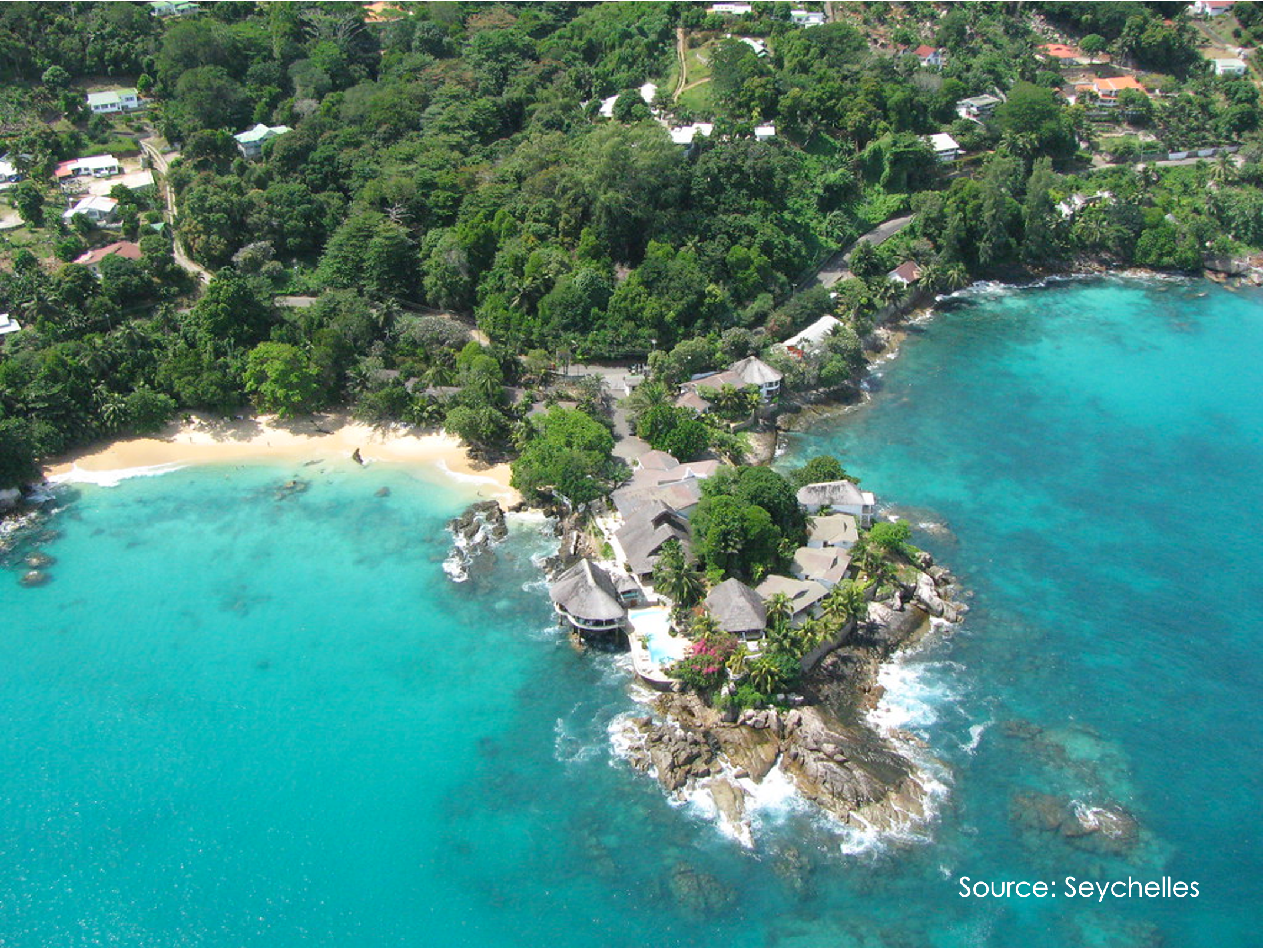
| Imagery Source: Flickr |
| Information Source: African Development Bank |
| Recent macroeconomic and financial developments |
| Real GDP growth in Seychelles moderated from a peak of 15% in 2022 to 2.5% in 2023. Tourism and fisheries remained supply-side growth drivers, while household consumption and investment were the main demand-side growth drivers. Tourist arrivals rose 5.7% in 2023 compared with 2022. Monetary policy remained accommodative, as inflation dipped from 2.6% in 2022 to –1.0% (deflation) in 2023. The main reasons for the deflation were low global fuel and food prices (the country’s main imports), falling freight costs, and appreciation of the rupee (owing to increased tourist arrivals). |
| The fiscal balance widened from 1.5% of GDP in 2022 to 1.9% in 2023. The debt-to-GDP ratio declined from 58.9% in 2022 to 56.7% in 2023, reflecting a strong recovery and good public debt management. The current account deficit widened from 6.9% of GDP in 2022 to 8% in 2023 as import costs rose. External reserves improved from 3.2 months of import cover in 2022 to 3.7 months in 2023. The financial sector remained well capitalised, although highly concentrated, with the three largest banks holding 80% of total assets, deposits, and loans. Bank nonperforming loans rose slightly from 6% of gross loans in 2022 to about 7% in 2023, mainly related to borrowing during the COVID-19 pandemic. |
| Social development indicators remain strong. Poverty is low at 0.5% in 2022/23, down from 0.7% in 2021. Unemployment remained low, at 3% in 2022 and 2023. |
| Outlook and risks |
| GDP growth is projected to improve to 4.0% in 2024 and 4.3% in 2025 amid sustained tourism receipts and enhanced performance of information and communication and financial services in line with priorities of the 2024–2028 National Development Strategy. Inflation is projected to rise to 1.4% in 2024 and 2.2% in 2025 as electricity tariffs and global food and fuel prices rise. Tourism and fisheries will remain key supply-side growth drivers. The fiscal deficit is projected to improve to 1.5% in 2024 and 1.3% in 2025 as revenue collection improves. |
| The current account deficit is expected to narrow slightly and stabilise at 7.2% in 2024 and 2025, reflecting the continuing recovery of tourism, while foreign reserves are projected to reach 3.9 months of import cover in 2024 and 2025. Downside risks to the economic outlook include disruptions to global supply chains from Russia’s invasion of Ukraine and the Israel–Hamas war. Economic diversification and a continuing focus on renewable energy sources remain key for sustained growth and resilience. |
| Reform of the global financial architecture |
| Structural transformation of the economy has been slow over the last decade. Agriculture’s share of GDP remained unchanged at about 2.5% from 2010 to 2021, and industry’s share remained at around 15%. Within industry, manufacturing’s share was low and falling, declining from 10.5% in 2012 to 8.3% in 2021. Consequently, services’ share remained dominant, at 82% to 84%. Within services, tourism maintained its top position, at around 31%. Movement of labour from high- to low-productivity sectors was slow. Agriculture’s employment share remained around 1% between 2012 and 2021, and manufacturing’s at around 9%. The employment shares of emerging sectors such as financial and information technology services hovered around 5%–6%. The small size of the domestic market, shortages of skilled labour, inadequate access to finance, high electricity costs, and climate change risks impede structural transformation. |
| With the declining availability of financing from international markets and Seychelles’ small domestic market, the global financial architecture is impeding its efforts to address these challenges of structural transformation. Moreover, as a high-income economy, Seychelles is not eligible for concessional financing. The global financial system should evolve to consider the unique challenges and vulnerabilities of small island developing countries like Seychelles to offer financing that can enable them to accelerate their structural transformation. Structural transformation is one of the six pillars of the country’s 2024–2028 National Development Strategy. |
| For the full documentclickck the link below |
| Seychelles: Economic Outlook and GDP |
| Stay ahead of the curve! Subscribe to InsidEntity for daily updates on all your favourite companies. |