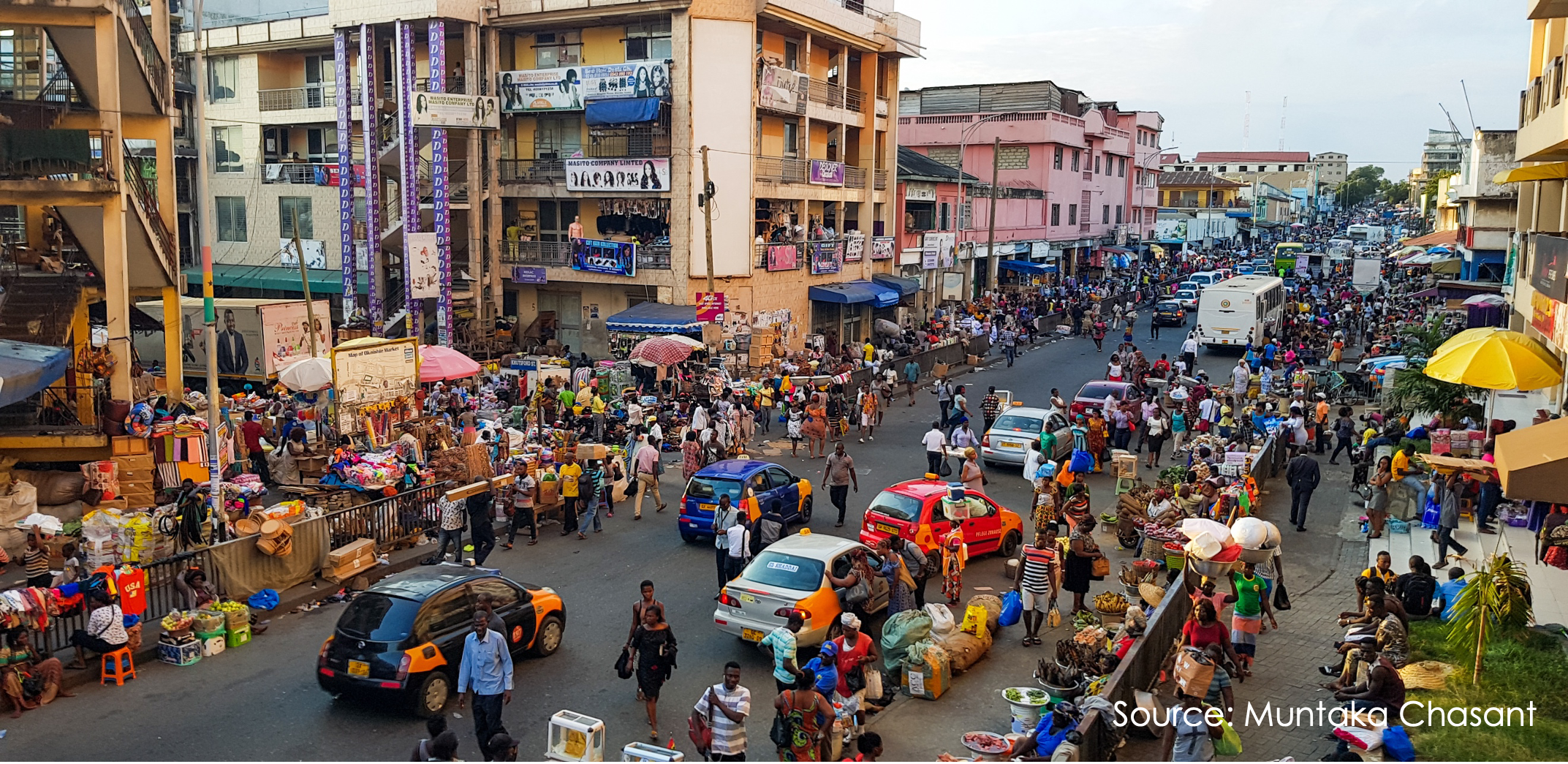
| Imagery Source:Wikimedia Commons/ Muntaka Chasant |
| Information Source: African Development Bank |
| Recent macroeconomic and financial developments |
| Ghana’s real GDP growth decelerated from 3.8% in 2022 to 2.9% in 2023, reflecting spillover effects from Russia’s invasion of Ukraine, tight global financial conditions, and macroeconomic challenges. Growth was led by industry on the supply side and by private consumption on the demand side. Inflation worsened from 31.5% in 2022 to 40.3% in 2023, driven mainly by food prices and currency depreciation. |
| The pace of exchange rate depreciation slowed from 60% in 2022 to 17% in 2023, responding to adjustments in macroeconomic policies. The fiscal deficit narrowed from 11.8% of GDP in 2022to 4.5% in 2023 due to fiscal consolidation and improved revenue performance. Public debt dropped from 92.4% of GDP in 2022 to 84.9% in 2023, reflecting the benefits of the Domestic Debt exchange Program. The current account deficit narrowed from 2.1% of GDP in 2022 to 1.7% in 2023 on improved export performance. Gross international reserves shrank from $6.3 billion at the end of 2022 (2.7 months of import cover) to $5.0 billion (2.3 months) in November 2023. The financial sector remained sound, with a capital adequacy ratio above the 10% threshold but declining (from 18.22% in 2022 to 13.96% in 2023). |
| Multidimensional poverty worsened slightly, from 46% in 2017 to 46.7% in 2022, due to the impacts of the Covid-19 pandemic. Youth unemployment remains high at 7.16%, particularly among youths ages 15–24, especially women (36.7% compared with 29.3% among men). |
| Outlook and risks |
| The medium-term growth outlook is positive. GDP growth is projected to rise to 3.4% in 2024 and 4.3% in 2025, led by industry and services on the supply side and private consumption and investment on the demand side. Inflation is expected to remain outside the Bank of Ghana bound of 8±2 at 20.9% in 2024 and 11.1% in 2025. The fiscal deficit is projected to widen slightly to 4.9% in 2024 before narrowing to 4.2% in 2025 as fiscal consolidation efforts continue. The current account deficit is projected to widen to 1.9% in 2024 and 2.3% in 2025. The outlook is clouded by several factors, including the impact of fiscal consolidation under the Post-Covid Program for economic Growth, the lingering effects of Russia’s invasion of Ukraine, limited access to finance and foreign exchange, and global macroeconomic shocks. Prudent macroeconomic management policies could mitigate the risks. |
| Reform of the global financial architecture |
| Ghana’s structural transformation needs reinforcement. Productivity has stagnated in services, the dominant employment sector, and is rising only slowly in industry and agriculture. Agriculture’s employment share declined from 53.9% in 2007 to 29.8% in 2019, while industry’s share rose from 14.1% to 21.0% and services’ share rose from 31.9% to 49.2% over the same period. To fast-track structural transformation, Ghana must enhance its competitiveness by easing infrastructure bottlenecks; accelerate agro-industrialization by strengthening skills development, value addition, and private sector development; and create a policy framework for technology adoption and innovation. |
| Financing structural transformation in Ghana requires selective investments in value-added activities that can drive the desired transformation. It also requires building resilience against global shocks, including measures to enhance macroeconomic management and domestic resource mobilization. Key reforms should include improving the coordination and sequencing of public sector development initiatives in line with the country’s fiscal position; fast tracking the ongoing debt restructuring, enhancing the scope for concessional finance, and deepening financial markets to increase access to affordable credit; and strengthening stakeholder engagement and coordination of development assistance to maximize synergies and impact. |
| For the full document, Click the link below |
| Ghana: Economic Outlook and GDP |
| Stay ahead of the curve! Subscribe to InsidEntity for daily updates on all your favourite companies. |